
WORKSAFE BC – REFUND OVERFUNDED SURPLUS TO EMPLOYERS (2025)
Issue
The BC WorkSafe Board of Directors has set a target funding level of assets over liabilities at no less than 130%. However, the current policy lacks an upper limit, leading to a significant surplus over the years. As of December 31, 2023, WorkSafeBC’s funding ratio was approximately 147% (down from 161% in 2020), with an unappropriated surplus of $1.95 billion and reserves of $5.1 billion. A structured refund mechanism is necessary to ensure these excess funds benefit employers while maintaining system stability.
Background
WorkSafe BC is a provincial agency entirely funded through mandatory employer premiums and investment earnings. These funds support workers' recovery from injuries, ensuring their return to safe and productive employment while providing equitable compensation. Employers finance the system through payroll levies, and WorkSafeBC also generates revenue from a diversified investment portfolio to cover future claims obligations.
The insurance fund was established to financially support workers’ recovery from injury and restore them to safe and productive employment and/or access to equitable compensation. The employers provide the funding based on a fee levied on their payroll. Revenues are also earned from a diversified investment portfolio held to meet future obligations on existing claims.
Measured by assessable payrolls, WorkSafeBC is the third-largest workers’ compensation board (WCB) in Canada. Over the past five years, WorkSafeBC’s funded level has consistently exceeded those of other major WCBs, including Ontario, Quebec, Alberta, and Saskatchewan. Only Manitoba, a smaller WCB, reported a higher funded level in 2023 and 2022.
Table 1: Comparative Analysis of Funding Levels
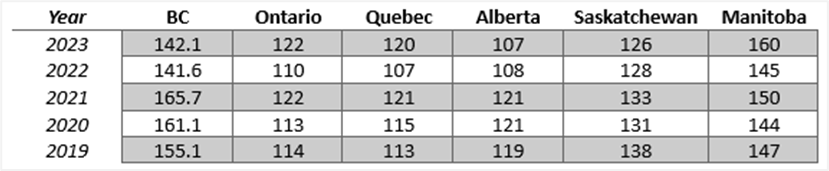
WorkSafeBC’s funding ratio remains significantly higher than most other provincial and territorial boards in Canada:
- Saskatchewan’s WCB targets a funding range of 100% to 140%. When exceeding 122%, surplus funds are returned to employers.
- Manitoba’s WCB in a 2023 funding level of 160%, the board refunded $118 million in 2024.
- Ontario’s WSIB targets 115% to 125%, %. In February 2025, Ontario’s WSIB refunded $2.0 billion to Schedule 1 Employers, following a $1.1 billion rebate in 2022.
These boards demonstrate proactive measures to return excess funds while maintaining financial health.
In contrast, WorkSafeBC’s overfunding position—exceeding its 130% target—has not been systematically addressed.
WorkSafeBC reported that its 2025 average base premium of 1.55% remains below the expected cost rate of 1.78%. Between 2019 and 2025, WorkSafeBC projects that $2.5 billion in surpluses will have been used to stabilize premium rates, averaging $357 million per year.
While maintaining premium stability is a prudent approach, WorkSafeBC still had over $800 million in excess unappropriated surplus as of December 2023. A structured policy is necessary to manage these excess funds effectively.
Table 2: Funding Ratio Analysis (Excess Over 130% Target)
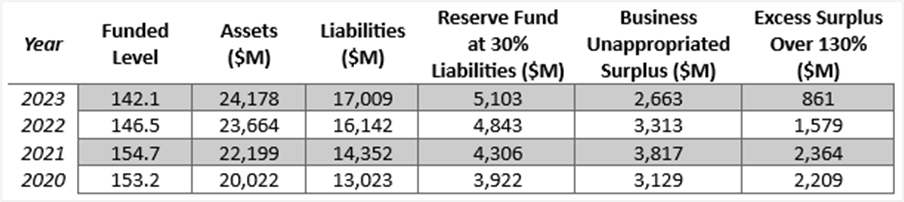
WorkSafeBC Board of Directors and management have a responsibility to the employers to revise its current funding ratio policy. What is required is an upper limit value. With a new upper limit set, a rebate policy should be included in the policy that allows the Board of Directors, at its discretion, to make direct payments to employers when that ratio limit is exceeded.
If due to the recognition of its large excess of Funds, WorkSafeBC made direct payments to employers, these funds could put to productive use, including investing in new and safer equipment, growing their business, and creating jobs.
THE CHAMBER RECOMMENDS
That the Provincial Government:
- Regularly disclose the rationale for funding range adjustments and surplus management strategies to stakeholders.
- Create an upper limit value for excess funds.
- Introduce a framework for direct surplus distribution to employers when funding levels exceed the policy range.