
STRENGTHENING NORTHERN BRITISH COLUMBIA’s TRANSPORTATION CORRIDORS TO DRIVE MAJOR PROJECTS (2026)
Issue
Northern British Columbia plays a foundational role in the provincial and national economy. This region – roughly the size of France - supplies energy, forestry, mining, agriculture, and tourism activity that supports jobs and revenue across the province and throughout the country. However, much of the transportation network that connects this region to Pacific ports and southern markets relies on aging two-lane highways, vulnerable river crossings, and insufficient rail capacity.
A modern, integrated transportation strategy for British Columbia must recognize northern and rural corridors as essential trade and supply routes, not secondary highways. Investment decisions should prioritize safety, reliability, and economic impact, with coordinated planning across highways, bridges, rail, and port connections.
Without a coordinated investment in highways, bridges, and rail infrastructure, these constraints will continue to raise costs for business, reduce safety, limit economic growth, delay final investment decisions on major projects, and weaken access to global markets.
Background
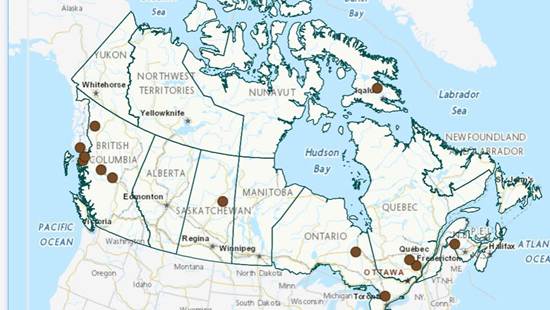
As the map above shows, five of the projects referred to the Major Projects Office for further review are located in Northern British Columbia.[1] These projects are:
- the Red Chris mine expansion
- the Ksi Lisims LNG project
- Phase 2 of the LNG Canada project
- Phase 2 of the North Coast Transmission Line
- Phase 3 of the North Coast Transmission Line
These five projects are massive, multi-year private and public-sector nation-building projects worth tens of billions of dollars.[2] The North Coast Transmission Line will not only connect Yukon to the Canadian energy grid, it will reduce carbon emissions by two to three million tonnes per year while powering Red Chris and other major mining projects in what is known as the Golden Triangle.[3]
Northern British Columbia highway and rail transportation corridors connect these projects – and many others currently in development or newly operational but not identified as major projects - to the ports of Port of Prince Rupert and Port of Vancouver, which are critical to Canada’s trade with Asia Pacific markets.[4] However, the current infrastructure is aging and requires significant upgrades, particularly at vulnerable bottlenecks, such as:
- The Highway 97 corridor between Dawson Creek and Fort St. John remains partially two lanes, despite heavy industrial and commercial use.[5]
- The Taylor Bridge is an aging structure in poor condition that serves as a critical link across the Peace River for northern communities and industry. Its condition and capacity limitations create both safety risks and economic vulnerability.[6]
- The Highway 97 Pine Pass through the Rocky Mountains connecting northeastern BC to the rest of the province has been identified as having a significant number of high-risk areas for closure due to extreme weather events.[7]
- In the Cariboo region, the Quesnel River Bridge is another aging crossing in poor condition while serving as an essential link in north-south trade and travel.[8]
Additionally, limited rail capacity, including restrictions on heavier carloads and insufficient branch line access, forces a higher share of freight onto highways, accelerating road deterioration and increasing collision risk.[9] Combined, these infrastructure deficiencies demonstrate the need for a coordinated approach from the provincial and federal governments.
The benefits from federal and provincial government investments in Northern B.C. transportation infrastructure include:
- Boosting investor confidence in the viability of major projects.
- Quicker, safer, more reliable access to national and global markets.
- Building supply chain resilience through upgraded highways, stronger bridges, and improved rail alternatives that reduce the risk that a single incident or weather event cuts off communities or halts trade.
- Improving public and worker safety.
- Shifting appropriate freight to rail and upgrading infrastructure to modern standards reduces long-term maintenance costs and extends the life of highway assets.
The Chamber Recommends
That the Provincial and Federal Governments:
- Recognize Northern British Columbia transportation corridors as nationally significant trade routes that support Canada’s access to Asia Pacific markets.
- Adopt a Northern British Columbia transportation corridor strategy that identifies and prioritizes highway, bridge, and rail investments.
- Develop cost-shared funding for Northern British Columbia transportation infrastructure improvements.
- Prioritize infrastructure funding for projects that reduce heavy truck volumes on highways by strengthening rail alternatives and intermodal connections.
[3] https://www.canada.ca/en/privy-council/major-projects-office/projects/national.html#6, https://cmscontent.nrs.gov.bc.ca/geoscience/PublicationCatalogue/InformationCircular/BCGS_IC2022-05.pdf
[5] https://www2.gov.bc.ca/assets/gov/driving-and-transportation/reports-and-reference/reports-and-studies/highway-97-cariboo-north/alaska_hwy97_corridor_study.pdf
[6] https://www.structuremag.org/article/inspection-evaluation-and-rehabilitation-of-the-taylor-bridge-gusset-plates/
[7] https://pievc.ca/wp-content/uploads/2024/06/PIEVC-Meta-Analysis-Case-Studies-6-BC-MOTI-Case-Study-2024.pdf.