
KEEPING BC FORESTRY COMPETITIVE: IMPROVING ACCESS TO WOOD, JOBS, AND INVESTMENT (2026)
Issue
British Columbia’s forest sector is a cornerstone of the provincial economy, supporting tens of thousands of family-sustaining jobs, hundreds of communities, and a diverse value chain from silviculture to advanced manufacturing. Yet the sector is facing unprecedented pressure from rising costs, regulatory complexity, and constrained access to wood, and global market volatility.
Without timely action to improve access to economic wood and strengthen competitiveness, additional mill curtailments and closures are likely—impacting rural and First Nations communities, reducing public revenues, and undermining B.C.’s capacity to supply low-carbon building materials. The province requires a coordinated strategy to ensure forestry can continue to be a solution for housing, climate resilience, reconciliation, and economic growth.
Background
Forestry remains one of British Columbia’s largest export industries and a critical employer in every region of the province. In 2022, B.C.’s forest sector contributed $17.4B to provincial GDP, supported about 100,000 jobs (direct, indirect, and induced), delivered $9.1B in annual wages, salaries and benefits, and generated $6.6B in government revenues[1]. The forest sector also leads in Indigenous representation, with 4,800 Indigenous people directly employed in the sector[2]. Forest products are essential to addressing Canada’s housing shortage, replacing higher-carbon materials, and advancing a bioeconomy that utilizes more of every tree. They are a large share of provincial exports, representing roughly 20% of total merchandise exports by value[3].
However, the operating environment has deteriorated significantly, and the sector is under sustained pressure. Softwood lumber production in the province has fallen by roughly 60% since 2016[4], and the province has seen 21 permanent or indefinite mill closures since 2023[5] with significant impacts on contractors, suppliers, local communities, and First Nations:
- Access to wood has become unpredictable. Lengthy and duplicative permitting processes delay harvesting approvals, leaving mills unable to plan production and workforce needs with confidence.
- Costs in B.C. exceed competing jurisdictions. Administrative burden, overlapping regulations, and escalating fees have reduced investment and eroded global competitiveness. Delivered wood costs in BC has outpaced all other North American jurisdictions with costs rising 77% since the year 2000.[6]
- BC Timber Sales is not delivering as intended. The program was designed to provide a stable, market-based log supply, yet volumes and timing have become inconsistent, affecting companies throughout the forest value chain. They have consistently underperformed over the past several years, with the 2025 fiscal year recording harvest levels 40% below their rationalized apportionment[7].
Table 1 – Decline in Forestry Jobs
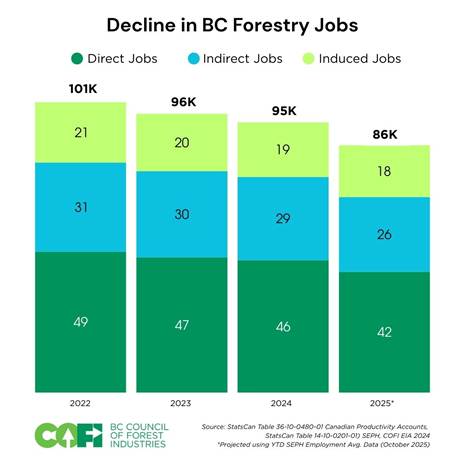
The layering of these impacts has resulted in BC forestry jobs (direct, indirect and induced) declining from 101k to 86k in the last four years, as shown in Table 1 above.[8]
At the same time, active forest management is increasingly important for wildfire risk reduction, ecosystem restoration, and climate adaptation. When logs cannot move from the forest to mills in a timely way, communities lose jobs, forests become more vulnerable to fire and decay, and opportunities for value-added manufacturing are missed.[9]
A competitive and predictable forest sector is therefore not only an economic priority—it is central to community resilience, reconciliation, and environmental stewardship.
The Chamber Recommends
That the Provincial Government:
- Conduct an internal audit to identify efficiencies and automation opportunities that will streamline the permit development processes, reduce administrative burden, and enhance coordination across ministries, with the goal of accelerating access to economic fibre so timber reaches mills in a timely way.
- Conduct an internal audit with the goal of improving the cost structure by rationalizing cumulative regulatory, administrative, and fee-related pressures affecting harvesting and manufacturing, and ensuring new policies consider impacts on delivered wood costs and global competitiveness.
- Deliver a reliable and competitive supply of logs through BC Timber Sales to support independent mills, contractors, and workers, with transparent volume targets and improved auction scheduling.
- Provide First Nations with the capacity, tools, and revenue-sharing mechanisms needed to expedite referrals, participate in tenure and manufacturing opportunities, and advance shared economic and stewardship objectives.
- Explicitly integrate active forest management as a tool for provincial climate adaptation and wildfire mitigation strategies. Proactive forest management tools such as fuel reduction, salvage, thinning, and prescribed burning support resilient working forests that both store carbon and reduce emissions.
[1] https://cofi.org/new-cofi-economic-impact-study-affirms-forest-industry-vital-to-provincial-economy/
[3] https://catalogue.data.gov.bc.ca/dataset/ca3ad618-b023-4f22-b3f2-e9de1bee92d3/resource/596619b7-990f-44c1-a5cd-7753f3a3a540/download/exp_annual_bc_exports.pdf
[4] https://www150.statcan.gc.ca/t1/tbl1/en/tv.action?pid=1610001701
[5] https://www.biv.com/news/resources-agriculture/bc-forest-sector-faces-another-tough-year-in-2026-11793817
[6] https://cofi.org/wp-content/uploads/OKelly-Acumen-Competitiveness-Sustainability-Study-in-the-BC-Forest-Sector-Technical-Report.pdf
[7] https://www2.gov.bc.ca/assets/gov/farming-natural-resources-and-industry/forestry/bc-timber-sales/business-plans-performance-reports/fy2025_bcts_licence_issued_public_report_-_fullyear_byquarter.pdf