EMPOWERING B.C.’s CRAFT DISTILLERIES TO FUEL LOCAL PROSPERITY (2026)
Issue
British Columbia is home to approximately 85 craft distilleries. They are found in communities small and large across the province. Yet craft distilleries face structural barriers that limit their ability to grow, compete fairly, and contribute fully to local economic resilience, despite being deeply embedded in local value chains and communities.
We need to encourage local investment, innovation, and employment in BC by addressing the barriers faced by local BC craft distilleries that are in place through low production caps, high markup structures at BC Liquor (BCL) Stores, and high federal excise rates.
Background
Craft Distillers in BC
In 2013, the BC Provincial Government established two categories of distilleries in BC: “Commercial” and “Craft”.87F Commercial distilleries can be of any size, and they can use anything to distill, including Neutral Grain Spirit (NGS) – alcohol that is distilled by large-scale distilleries, primarily from corn, and sold to other users, while also being a finished product itself.
The “Craft” designation means a BC distillery must:
- Produce no more than 50,000 litres of spirit per year (for context, a large distillery can produce 2 to 3 times this per day),
- Use 100% BC agricultural products to produce the alcohol from fermentation, and fermentation must be completed onsite at the Distillery.
- Use no additives, preservatives or artificial flavours.
In turn, craft distilleries benefit from “community-scale” support such as being able to sell directly to consumers through on-site sales, tasting rooms, and local farmers markets. They may also sell directly to local restaurants and private retailers.
There are approximately 85 craft distilleries in operation across communities in BC.[1]
Economic importance and local value chains
Craft distilleries transform low-margin B.C. grain into high margin spirits, with one tonne of grain yielding roughly 600 L of finished spirit and up to $30,000 or more in retail product value before taxes and markups. This transformation creates local jobs in farming, trades, production, design, marketing, and hospitality, amplifying the value that stays within B.C.’s communities.
As with the Okanagan wine industry, locally produced, branded spirits can become export ready products that showcase B.C. internationally while supporting domestic supply chains and regional tourism.
Vulnerability revealed by disruptions
The 2025 BCL strike, combined with ongoing tariffs and supply chain disruptions, exposed how heavily B.C. relies on complex, external supply chains dominated by businesses with a limited local footprint. These shocks had cascading impacts on the hospitality sector and local businesses that rely on stable access to products, highlighting the need for stronger local production capacity and more resilient supply chains.
Allowing B.C. craft distilleries to scale and diversify production would mitigate future risks by increasing local self-reliance and reducing exposure to global disruptions beyond the province’s control.
Regulatory and fiscal barriers limiting growth
The 50,000L production cap for B.C. craft distilleries artificially restricts growth, discourages capital investment, and limits economies of scale, while large spirit brands, breweries, and wineries operate with far more flexible regulatory conditions. This creates a structural disadvantage for small B.C. producers and suppresses the sector’s economic contribution and export potential.
A 142% markup applied to craft spirits sold through BCL Stores is significantly more punitive than the effective treatment of many B.C. wines and beers, especially for premium spirits, constraining market access, brand recognition, and revenue available for reinvestment.
Federal Excise Tax
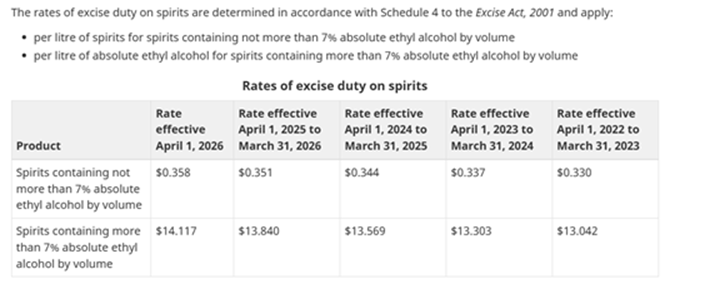
Federal excise rates for spirits are disproportionately high. Craft spirit producers now pay $14.117 per litre of bottled spirit compared to $0.358 per litre for beer, meaning roughly 40 times‑ more excise per volume[2]. This disparity undermines profitability for small distilleries, especially in a capital intensive‑ industry, and stands in contrast to the more favorable, tiered excise structures that have supported growth in the craft beer and wine sectors domestically and internationally.
The United States applies a federal excise tax of about $13.50 per proof gallon (roughly $2.80 per litre of pure alcohol) on spirits. This rate is much lower than on beer per volume, with reduced rates for small producers spur growth. The U.S. adopted reduced excise rates for craft producers (CBMA) explicitly to support small businesses and investment[3].
Australia uses a volume-based system starting at around AUD $108 per litre of pure alcohol[4] (about CAD$103) but offers concessional rates for low-alcohol products and supports craft distillers through rebates, fostering industry expansion. These jurisdictions demonstrate that lower, tiered excise duties encourage investment, supports small domestic producers, and drive long-term sector growth without undermining revenue.
Need for parity and policy alignment
Unlike breweries and wineries, B.C. craft distilleries have not yet received comparable excise relief or regulatory flexibility, despite operating within the same highly regulated distribution system and competing against large international brands.
Craft spirits from B.C. distillers are premium products, often priced at $50–$100+ per bottle due to artisanal methods, local ingredients, and small-batch production. Their high-cost targets consumers seeking quality over quantity. These premium priced products are not targeting high-volume or budget drinkers who might be targeted through harm reduction taxation policy in support of health initiatives. British Columbia is home to Craft distilleries in communities small and large across the province. We can encourage local investment, innovation, and employment in BC by supporting local BC craft distilleries with higher production caps, competitive markup structures at BC Liquor (BCL) Stores, and more equitable federal excise rates.
The Chamber Recommends
That the Provincial Government:
- Increase production cap to ensure craft distillers can operate and scale profitably
- Raise production caps for B.C. craft distilleries so they can scale operations without losing key benefits tied to their “craft” status.
- Ensure that the structure of revised thresholds promote investment, innovation, and job creation across the sector while maintaining appropriate public health and safety oversight.
- Support BC distillers through reduced BCL Stores markups and in-store visibility.
- Reduce the BCL markup so B.C. craft spirits can be sold in BCL stores at a competitive price within each product category, and that aligns with the treatment of B.C. wine and beer.
- Design markup reforms to improve visibility and competitiveness of local BC spirits on BCL shelves, supporting brand recognition, revenue growth, and reinvestment in local facilities and employment.
- Advocate for reduced federal excise tax structure for small distilleries
- Work with the Government of Canada and other provincial partners to implement a tiered or reduced federal excise tax regime for craft spirit producers, comparable to the relief already provided to small breweries and wineries.
- Support reforms that align B.C. practice with other countries who have demonstrated that reduced excise encourages investment and long‑term sector growth.