
CHARTING A SUSTAINABLE FISCAL PATH TO RESTORE STABILITY (2026)
Issue
British Columbia’s fiscal health is at a critical juncture. Budget 2026 outlook reveals a structural operating deficit, with no clear path back to a balanced budget. Rising provincial debt, persistent deficits, and increasing interest costs are placing long-term fiscal sustainability at risk. This raises concerns about business confidence, investment, and B.C.’s ability to invest in and respond to future priorities and unexpected challenges in a growing economy. Restoring fiscal discipline and principled public finance management is urgently needed to ensure a stable and competitive future.
Background
For decades, British Columbia’s fiscal strength helped attract capital and investment. However, recent provincial budget trends signal a weakening of this advantage as deficits grow and debt continues to rise, which underscores the unsustainable path the province is currently on. This shift matters as a weakening fiscal position can affect investor confidence, increase borrowing costs, and limit the province’s ability to create a stable, competitive environment for businesses to grow and invest.
Without a clear and transparent commitment to returning to balanced budgets, the province risks entrenching a high-debt, high deficit, high-interest trajectory that could undermine long-term economic competitiveness and public prosperity.
Current Fiscal Outlook
Over the past few years, B.C.’s budget deficit and debt have been on the rise. The budget deficit more than doubled, from $5 billion in 2023/24 to an estimate of $13.3 billion in 2026/27, according to Budget 2026. Concerningly, net debt is growing significantly faster than the underlying economy at the rate of 2.5 times. While GDP is expected to grow by 1.3% in 2026[1], the province’s net debt-to-GDP ratio has increased from 23.2% to 26.4% in just one year – well above the historic average of 15.5%.[2] This means debt is accumulating faster than the economy is growing, increasing the relative debt burden over time.
Graph 1: B.C.’s Debt-to-GDP Ratio (2013/14 – 2027/28) 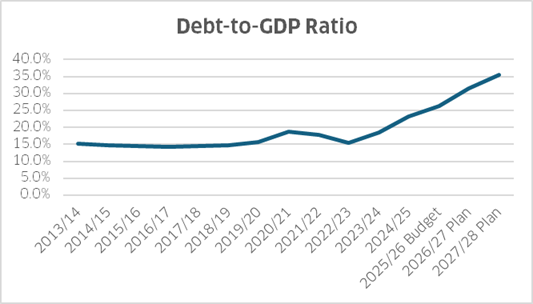
Table 1: B.C.’s Deficit, Debt and Debt-to-GDP Ratio
Fiscal Year | Budget Deficit ($B) | Taxpayer-Supported Debt ($B) | Net Debt-to-GDP Ratio |
2023/24 (Actual) | $5.0 | $76.0 | 18.6% |
2024/25 (Actual) | $7.3 | $99.1 | 23.2% |
2025/26 (Forecast) | $9.6 | $116.5 | 26.4% |
2026/27 (Plan) | $13.3 | $142.9 | 30.6% |
2027/28 (Plan) | $12.1 | $166.9 | 34.4% |
Although B.C. continues to have relatively low debt levels compared to other provinces, it is now projected to rank in the middle range in 2027 alongside Ontario and Quebec, losing the low-debt positioning that has historically attracted global capital. While comparisons with peer jurisdictions can be useful, they may not fully capture how the province’s fiscal performance has shifted relative to its own historical trajectory — an important anchor for assessing long-term fiscal sustainability.
This context matters given ongoing tariff pressures coming from Canada’s largest trading partner over the past year. Provinces such as Ontario have faced direct impacts on major industries, while B.C.’s sectoral exposure has been different. Business Data Lab’s data suggests that cities in Ontario, Alberta, Quebec and New Brunswick are among the most vulnerable to U.S. tariffs.[3] Despite not experiencing the same magnitude of tariff-related disruption, the province’s fiscal outlook continues to deteriorate – indicating that the province’s fiscal challenges are structural, rather than primarily the result of external shocks.
Reflecting on the deterioration in fiscal trends, a survey by the Greater Vancouver Board of Trade found that 78%[4] of businesses believe it is urgent for the province to return to a balanced budget.
Credit Rating
While B.C. currently maintains one of the lowest debt levels among Canadian provinces, the impact of prolonged deficits and rising debt is starting to affect how the province is perceived as a borrower. Although the province’s credit rating remains within the Grade A range, recent downgrades by major agencies signal growing concerns over debt levels and deficit projections. In April 2025, two leading global credit rating agencies downgraded B.C.’s ratings: Moody’s lowered the rating from Aa2 to Aa1[5], and S&P Global Ratings downgraded from A-1+ to A-1[6]. S&P specifically cited “considerable” deficits and rapid debt accumulation, while warning of potential further downgrades in the next two years. Currently, four major rating agencies — Moody’s, Fitch, Morningstar DBRS, and Standard & Poor’s — have assigned B.C. a negative outlook.[7] In March 2026, Moody’s delivered its second downgrade, citing “a marked deterioration in the province’s credit fundamentals”[8] S&P[9] Weaker credit ratings can increase the government’s borrowing costs and affect investor confidence, making it more expensive to finance infrastructure and public investments.
The “Interest Bite”
The "interest bite" is a critical measure of fiscal health, indicating how much of the government’s revenue is consumed by debt servicing rather than invested in priorities such as services and infrastructure. It shows how many cents of every dollar collected in government revenue must go toward interest payments.
A rising interest burden reduces fiscal room and diverts resources away from public priorities. As more spending goes toward servicing debt, governments face difficult trade-offs, cutting services, delaying investments, or raising taxes, which can dampen growth and competitiveness. The latest provincial budget shows the interest bite rising from 5.1¢ to 8.0¢ per dollar of revenue by 2028/29, a 57% increase in just three years.
Table 2: B.C.’s Interest Costs and Interest Bite[10]
Fiscal Year | Interest Expense ($B) | Interest Bite (Cents per $1) |
|---|---|---|
2025/26 (Forecast / Budget 2026) | $5.3 | 5.1¢ |
2026/27 (Estimate / Budget 2026) | $6.5 | 6.3¢ |
2027/28 (Plan / Budget 2026) | $7.8 | 7.2¢ |
2028/29 (Plan / Budget 2026) | $8.9 | 8.0¢ |
Given the province’s current fiscal situation, economic growth and productivity need to be at the centre of government decision‑making to ensure spending remains prudent while maintaining service quality. The Greater Vancouver Board of Trade’s Agenda for Economic Growth campaign calls on government to focus on expanding the economy and generating the productivity gains required to sustain public services over the long term. A credible path to fiscal responsibility must also address the underlying spending and productivity challenges that determine whether government can deliver services effectively and efficiently.
Debt fueled spending and persistent deficits leave less room for investment in the services businesses and communities BC depends on. Without a credible path to reduce the deficit, the province sends negative signal to households and businesses that taxes will need to be substantially higher in the future to stabilize the government’s fiscal situation.
We need a clear and transparent plan to put provincial finances on sustainable footing, strengthen confidence, and create the conditions for private sector growth.
The Chamber Recommends
That the Provincial Government:
- Establish a credible fiscal plan that demonstrates a declining debt-to-GDP ratio, sets clear deficit reduction targets, and restores taxpayer-supported debt to sustainable levels consistent with historical averages, ensuring that fiscal choices reinforce long-term productivity and economic growth. The plan should include transparent quarterly reporting.
[2]https://economics.td.com/domains/economics.td.com/documents/reports/budgets/bc/BC_Budget_2025.pdf
[3] https://businessdatalab.ca/publications/which-canadian-cities-are-most-exposed-to-trumps-tariffs/
[7] https://www2.gov.bc.ca/assets/gov/british-columbians-our-governments/government-finances/debt-management/investor-presentation-december-2025.pdf
[8] https://www2.gov.bc.ca/assets/gov/british-columbians-our-governments/government-finances/debt-management/moodys-ratings-march-2026.pdf
[10] Table A19. B.C. Budget and Fiscal Plan 2026. P. 174. https://www.bcbudget.gov.bc.ca/2026/pdf/2026_Budget_and_Fiscal_Plan.pdf